Thank you, @Tristan_Hensley for this great tutorial on Transitions. Please feel free to post questions or concerns below!
Hello Pilots and Controllers!
In the past I have discussed how controllers and pilots should handle transitions when utilizing ATC on the Advanced Server. The ATC Administration Team has decided to make some changes on how we handle transitions to help minimize any confusion this has been causing. I am not going to go into detail about the “old way.” This is the way that we will be handling it from this point forward.
Transitions are only required if you are flying within 5 miles of a controlled airport (The center ring) and at or below the lowest altitude limit. When you click anywhere in the center ring, it will give you between 1 to 3 altitude ranges. The bottom range is what you should use. I will post pictures of a Class B Airspace, and a Class D airspace as an example so you can see what I’m talking about.
The first example is Palm Springs Airport in California (KPSP). If you click in the center ring of that airspace and then look in the top right corner, it gives you 3 different ranges of altitudes. What we will be using for transition purposes is the bottom range. So in this case is shows SFC-3000 (Meaning from the Surface up to 3000 feet). That altitude is in MSL. If you are flying at or below 3,000 feet and will get within 5 miles of the airport, you need to contact the tower and request a transition. The only exception to this rule would be if Approach Control is open. If Approach control is open, those controllers will communicate with each other and coordinate your flight, so you don’t have to.

If you are flying at 2500, and are going to pass by the airport 7 miles away, you are NOT required to contact the Tower. If approach control is open you would need to contact them. If you are flying at 4000 directly over the field, you do not need to contact the tower. Again, in this scenario, you only need to contact tower if you flying at or below 3000 feet, and within 5 miles of the airport.
In this next example, I will use KCRQ in Southern California. This is a Class D Airspace. When you click on the airport, it shows that the airspace is from the Surface to 2900 feet. So if you are at 3,000 feet, you do NOT need a transition. If you are flying within 5 miles of the airport and are at or below 2900 feet, you must contact the tower, if it is open, and request a transition.
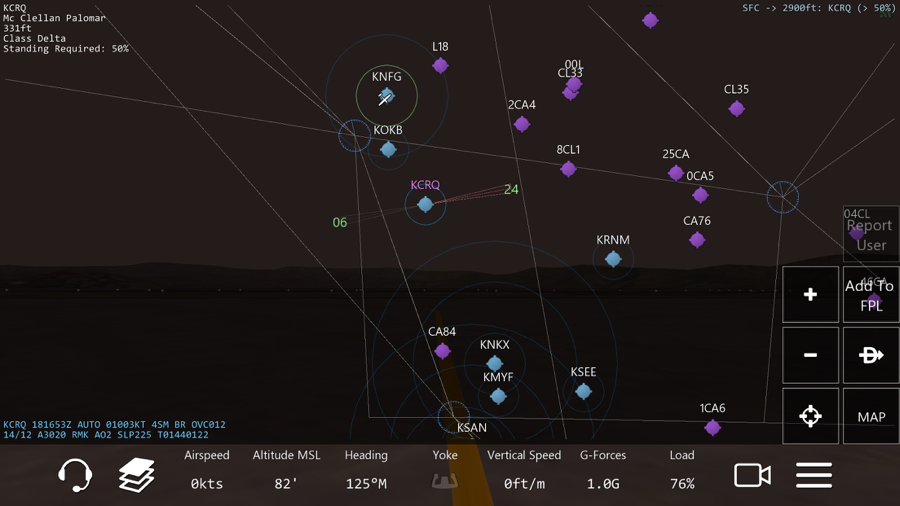
The most important part of all of this is that if you are flying more than 5 miles from ANY airport, you do not need a transition from the Tower. If you are going to be flying within 5 miles of an airport, you need to check the lower altitude limit on your map to see if you need a transition or not.
Note: If you think you are going to conflict with the traffic in any given controlled airspace, you always have the right to check in with that ATC Facility.
@Tristan_Hensley
ATC Recruiter/Supervisor